How to Write a Creator Briefing
Free Brief Template for Better Collaboration
Creator marketing is one of the most powerful tools in any brand's arsenal. But too many brands approach it wrong: they hand creators a list of things to say, a strict shot list, and a mandatory script. The result? Content that feels forced, performs poorly, and wastes everyone's time.
This guide walks you through Meta's proven creator briefing framework, section by section, so you can brief creators with clarity, inspire them with creative freedom, and get work that actually resonates with audiences.
If your DTC brand needs expert support sourcing the right partners and briefing creators to actually deliver results, Growth Collective can help. We’ve managed over $100M+ in profitable spend for leading brands, and we handle everything from partnerships to strategy and scaling. Book your strategy call here.
The Golden Rules of Creator Briefing
Before you open a doc and start typing, internalize these four principles. They apply to every brief you'll ever write.
- Keep It Brief: A shorter brief takes longer to write, but increases your chances of success. Too much information causes creators to lose sight of what you really need.
- Collaborate: Engaging with a creator is a partnership, not a one-way street. Ideate together and find the right idea collaboratively. Use your brief as a start point for co-creation.
- Inspire: Take time to bring your brand to life and excite your creator. Consider mood-boards and visual references, not just boxes filled with words.
- Don't Confuse Brief with Contract: A brief aligns you on creative goals. A contract covers legally binding specifics: payment, usage rights, territories, disclosure, exclusivity. They are separate documents.
The Three Phases of a Creator Brief
Every strong creator briefing moves through three phases. Think of them as a journey: from inspiring the creator, to giving them brand context, to nailing the logistics.
Phase 1. The Creative Ask: Why you, the ask, the idea, and key messages.
Phase 2. Brand, Campaign & Product: Objectives, brand story, product info, and assets.
Phase 3. Deliverables & Process: Reels tips, point of contact, timeline, budget, usage rights.
The Full Brief Template
Every field is explained in detail in the sections below.
- Brief from: Your company and brand name.
- Brief to: The creator's name and handle.
- Briefing date:
- Content deadline: When do you need the content? If adapting it, leave time for editing.
- Posting date: When will your campaign go live?
- Why you?: What you love about the creator's content, craft, personality or perspective. Add examples.
- The ask: What you're looking for, your campaign deliverables, summarised clearly.
- The idea: A creative frame or start point for the creator to interpret.
- Key messages: The single most important thing you want the audience to understand.
- Campaign objectives: Your business objectives and overall campaign goals.
- Brand background: Brand history, personality, assets (logos, product shots in linked folder).
- Product info: What's relevant for the creator to know. Don't overload with messaging.
- Reels best practices: Audio rights, safe zone, pacing tips for paid ads.
- Creator point of contact: Who is the primary point of contact?
- Review process: How will you collaborate? Who needs to sign off?
- Usage rights: E.g. paid media, 3 months.
- Budget & payment: Fee and/or any payment incentives (e.g. fee per conversion).
Phase 1: The Creative Ask
This is the heart of your brief. Get this section right, and everything else flows from it. It has four parts: Why You, The Ask, The Idea, and Key Messages.
1. Why You?
You've chosen your creator because of their unique style, perspective, or personality. Tell them what you love about their work, so they know what to lean into, and what not to lose while delivering the content you want.
Your "why you" can be a paragraph or a sentence. Not a word person? Include one or two examples of the content that caught your eye. Or do both.
Example
Beauty brand to lifestyle creator: "We love your bubbly and cheeky personality and the way it shines through in your content. The playful creativity in this post, for instance, would really help us in repositioning La Leuer to a younger audience who know skin care is important, but don't want to take it too seriously."
More "Why You" Examples by Creator Type
For a creator with a flair for situational comedy: "We live for your hilarious, witty and unapologetic POV. We love your never-sugar-coated, direct-to-camera, unscripted approach to content creation, and encourage you to bring as much of that to the creative as you can. We're providing key messaging with very few mandatories and hope that you will freestyle, riff, and ad-lib the way you do in all of your most viral videos."
For a craft creator specialising in CGI videography: "Our team routinely obsesses over your content for its innovative fusion of tech, graphic design, and storytelling. Your ability to create engaging visual narratives that captivate and educate are the reason why we're so excited to work with you on this campaign. Your signature aesthetic (visually stunning, interactive, forward-thinking) is exactly what we're looking for."
For a creator with science-based beauty expertise: "We love how you blend clinical expertise with a warm, relatable approach to beauty, particularly the way you can break down the 'why' behind product performance. The vibe feels deeply rooted in expertise while also connected to a personal and unique POV. Your credibility is gold to us. You make beauty feel smart, effortless, and aspirational without trying hard."
2. The Idea: Give Them a Frame, Not a Script
Give creators a frame to work within, or an idea to interpret, so they can translate your message through their authentic voices. This is one of the most important distinctions in creator marketing.
Don't say: "Create 1 reel, 1 post and 1 story and talk about how much you love our shampoo."
Do say: "Our brand believes hair is a tool for creativity! Show us who you are by visualizing how creative you can be with your hair."
Creators often feel more engaged in the brief if they're asked to bring their own creativity to the partnership. Having an idea to interpret is often more inspiring for a creator than a detailed checklist.
Where to Find Your Idea
An idea doesn't need to be a big creative concept. It could be a tagline, a product benefit, a hashtag, a trend, or even a piece of original audio, as long as it gives your creators something to creatively interpret.
Option 1. Start with product benefits: Think about functional and emotional benefits. E.g. a shampoo that makes people feel confident. Ask: "Show us what 'confidence' means to you!"
Option 2. Start with brand values: Look at your brand values, vision, promise, or personality traits. E.g. a finance app that makes saving "easy". Ask: "Dramatize how easy it is to save money with your app."
Option 3. Start with a Reels trend: Is there a Reels story type or evergreen trend that fits your brand? E.g. spacious, versatile handbags. Ask: "Use the 'get ready with me' Reels trend and weave in your product."
3. The Ask: Summarise What You Want
Summarise what you want your creator to do. No need to get too detailed, and no need to get poetic. Just give them a clear sense of what you're looking for. Include a reference example if it helps.
Example ask, cosmetics brand: "We're looking for a selfie-shot style makeover using transitions to demonstrate the infinite variety of looks you can get when using La Leuer cosmetics. We think this video you did a few months back really captures the ideas of playfulness and variety, but we'd like to see more of the process of how everyone can 'get the look' with minimal fuss or skill."
4. Key Messages: One Message, Not Ten
If your audience only remembers one thing about your product, what do you want that to be? This section is about restraint.
Don't ask your creator to communicate too many messages about your product, make sure you leave room for their personality to shine. Overloading the key messages section is one of the most common brief mistakes.
Keywords
Words you'd love the creator to use naturally in their content. List them out and invite the creator to suggest their own.
Example: "We want our audience to feel that our brand is vibrant, fun and light-hearted. Use these words if you can, as long as it feels natural: Fun, vibrant, colorful. Feel free to suggest other words too."
Product Features
Creators are more believable when they demonstrate product knowledge. List your product's most important features, including pronunciation if needed.
Example: "Please mention the product range name 'LaLueur Color Cosmetics' (pronounced 'La Loo-er')."
Product Benefits
What benefits do those features deliver? Keep it to one or two, and include a clear call to action.
Example: "All natural ingredients. For every skin type. And don't forget the CTA: 'Swipe up to shop now!'"
Phase 2: Brand, Campaign & Product
Now that you've set the creative direction, give your creator the context they need to bring it to life. They don't need everything, just what's essential to do a great job.
Campaign Objectives
If the creator's work is part of a wider campaign, share the context. They should understand how their content fits into the bigger picture. You don't need to give them tons of information, just what they really need to know to help them do a great job.
What to include:
- Business objectives: what you're trying to achieve and why, e.g. reaching a new demographic, driving awareness of a new product line, repositioning the brand.
- Campaign idea: if you have an overarching campaign concept, share it.
Example campaign context: "La Leuer has a loyal following amongst women in the 35+ age bracket, but we want to appeal to a younger demographic by repositioning the brand as playful, vibrant and lighthearted. Our overall campaign idea is 'Play with Color'. We'll be engaging 3 different creators to introduce the brand as fresh, exciting and creative."
Brand Background
What is your brand about? What does it stand for? Distil the essential brand information down to a short paragraph, a few sentences, or even a visual summary. Include your competitive context if useful.
Consider providing your creator with a moodboard of your brand's visual language or personality. Is your brand like a breezy, sunny day? Or a rollercoaster ride? Show them with imagery that brings it to life. If you have a visual theme for your wider campaign, give them clues about what it should look and feel like.
Example brand background: "La Leuer was founded in 1978 in Paris by a husband and wife team who saw a need in the beauty market for products made with natural and organic ingredients for all skin types. To this day, the brand only uses hand-sourced, sustainably produced ingredients. Competitive set: La Reve, Silkesse, Bright."
Brand Assets & Equities
Let your creator know what brand assets they should include in their content (colours, shapes, motifs, mascots, catchphrases, product packaging). This way they can weave them into their creative in a thoughtful, unforced way.
Example: "Think about any playful, creative ways you can integrate our brand assets, like our colour palette and products, into your content."
Phase 3: Deliverables, Process & Production
Locking In the Practicalities
You don't want to lead your brief with a list of deliverables, but you do need to spell it out at some point. Be as specific as possible.
Reels Best Practices for Paid Ads
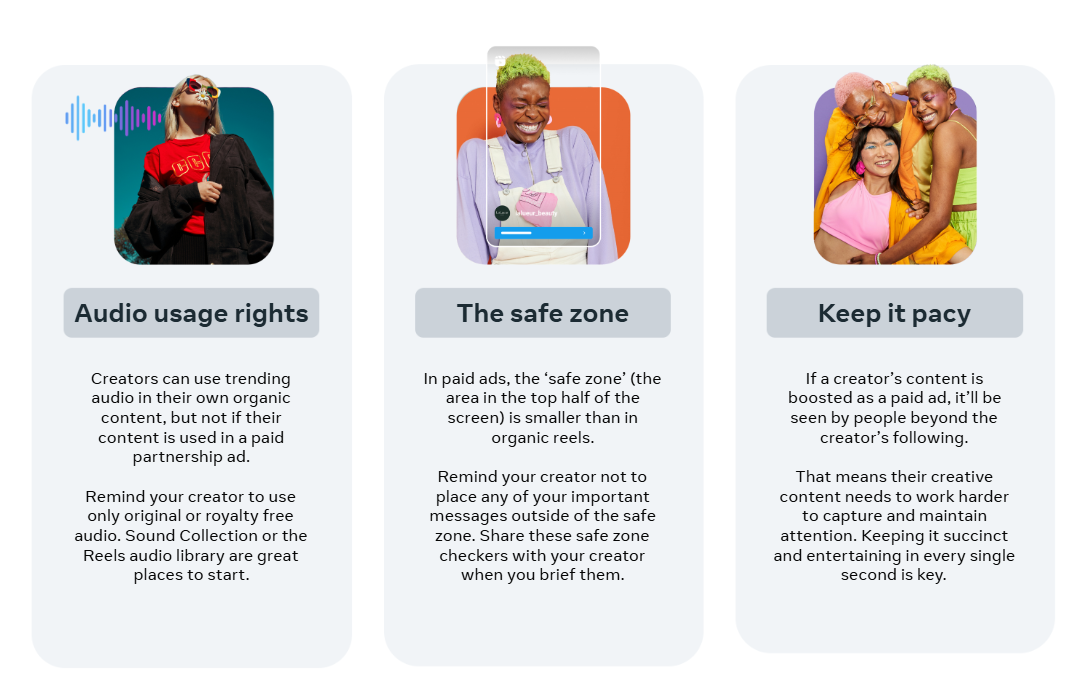
Creators are great at building captivating video, but they're not advertisers. They may not be aware of best practices that apply when content is boosted in a paid campaign. Always include these three points in your brief.
Audio Usage Rights: Creators can use trending audio in organic content, but not in paid partnership ads. Remind them to use only original or royalty-free audio. Sound Collection or the Reels Audio Library are great starting points.
The Safe Zone: In paid ads, the safe zone (top half of screen) is smaller than in organic Reels. Remind your creator not to place important messages outside this area. Share safe zone checkers when you brief them.
Keep It Pacy: If content is boosted as a paid ad, it'll be seen beyond the creator's following. Creative needs to work harder to capture and maintain attention. Every single second should be succinct and entertaining.
Deliverables, Budget & Timeline
Be specific. Vague deliverables create misaligned expectations and revision headaches.
Deliverables
Be exact: Approx. 25-second Reel showing 5–6 different looks using different combinations of eye shadow, rouge and lipstick: each look 4–5 seconds long. Still image showing product in foreground with your most successful makeup look. If editing to a different ratio (e.g. 4:5), flag this so the creator shoots with that in mind. Specify whether you want the product visible in every shot or just key moments.
Timeline
Include key milestones: First storyboard / concept (e.g. June 6th). First draft delivery (e.g. June 12th). Final delivery (e.g. June 16th).
Budget & Usage Rights: Agree a flat fee and/or any performance-based incentives (e.g. fee per conversion). Specify duration and channels for usage rights, e.g. "Paid media, 3 months, across digital."
Build b-roll footage or additional textural video into your contract so you have more material to play with when editing. It costs almost nothing extra to ask for, and gives you far more creative flexibility in post-production.
Your Pre-Send Checklist
Before you share your brief with a creator, run through these questions:
- Have you told the creator why you chose them specifically?
- Have you given them a creative frame, not just a list of deliverables?
- Is your key message limited to one or two things?
- Have you provided brand context, story, values, assets?
- Have you included the three Reels best practices for paid ads?
- Are your deliverables, timeline, and budget clearly spelled out?
- Have you left room for the creator's personality to shine through?
- Are your contract and brief separate documents covering different things?
If your DTC brand needs expert support sourcing the right partners and briefing creators to actually deliver results, Growth Collective can help. We’ve managed over $100M+ in profitable spend for leading brands, and we handle everything from partnerships to strategy and scaling. Book your strategy call here.
-
Based on the Meta Creative Shop Creator Briefing Playbook. All information sourced from the official guide.