Advanced Google Ads Strategies for Ecommerce Growth
If you want to scale to $10M profitably and sustainably, it’s time to shift your perspective.

Hitting the $3M to $5M revenue mark is a massive achievement for any e-commerce brand. You’ve proven your product-market fit, built a customer base, and established reliable fulfillment. But the strategies that got you to $5M rarely work to get you to $10M.
At this plateau, scaling often feels like a trap: you spend more on ads, but your profit margins shrink. Many brands fall into the trap of relying entirely on social platforms like Meta for growth, treating Google Ads as nothing more than a bottom-of-funnel net to catch people already searching for their brand.
If you want to scale to $10M profitably and sustainably, it’s time to shift your perspective. Google Ads isn't just a search directory; it is a full-funnel profit engine. Here is how to move beyond basic keyword targeting and unlock advanced Google Ads strategies for true e-commerce scale.
1. Google Ads as a Full-Funnel System
To scale to eight figures, you cannot just capture existing demand; you must generate it. An advanced Google Ads strategy leverages the entire Google ecosystem to move users seamlessly from discovery to purchase.
- Top of Funnel (Demand Generation): YouTube and Demand Gen campaigns are your television commercials, but highly targeted. Use high-quality video assets to introduce your brand to new audiences based on their interests and online behaviors.
- Middle of Funnel (Consideration): Display Network and Non-Brand Search capture users who are researching solutions but haven't chosen a brand yet. Broad match keywords (paired with smart bidding) allow you to uncover new search queries you might never have thought to target.
- Bottom of Funnel (Demand Capture): Search (Brand & High-Intent) and Shopping are where the transaction happens. This is where you dominate the SERP (Search Engine Results Page) when the user is holding their credit card.
Pro Tip: Don't silo these campaigns. Ensure your tracking is set up to measure how a YouTube view eventually led to a Search conversion days later.
2. Mastering Advanced Bidding and Automation
The days of manual CPC (Cost Per Click) bidding are over. Getting to $10M requires leaning into Google’s machine learning, but doing so intelligently. Automation is only as good as the data you feed it.
- Performance Max (PMax): PMax is essential for modern e-commerce. It dynamically allocates your budget across Search, Shopping, YouTube, Display, and Maps to find conversions. The key to winning with PMax isn't setting it and forgetting it; it's optimizing your Asset Groups (images, videos, copy) and providing high-quality Audience Signals to point the algorithm in the right direction.
- Value-Based Bidding (VBB): Stop bidding for clicks or flat conversions. Transition to Target ROAS (tROAS) or Maximize Conversion Value. This tells Google to prioritize users who are likely to buy higher-margin products or fill larger basket sizes, rather than just users who buy the cheapest item in your store.
3. Audience Segmentation: Turning Data into Experiences
Privacy updates and cookie depreciation have made third-party data less reliable. At the $5M+ mark, your biggest asset is your first-party data.
- Customer Match: Upload your customer lists (segmented by purchase behavior, VIP status, or churn risk) directly into Google Ads. You can use this to aggressively bid on past customers when they search for complementary products, or exclude them from acquisition campaigns to save budget.
- Predictive Audiences: If you use Google Analytics 4 (GA4), leverage predictive audiences to target users who have a high probability of purchasing in the next 7 days, or users who are likely to churn.
- Personalization at Scale: Align your ad copy and creative with the audience segment. A returning VIP customer should see a different ad message (e.g., "Welcome back, see our new collection") than a cold prospect ("Discover the brand everyone is talking about").
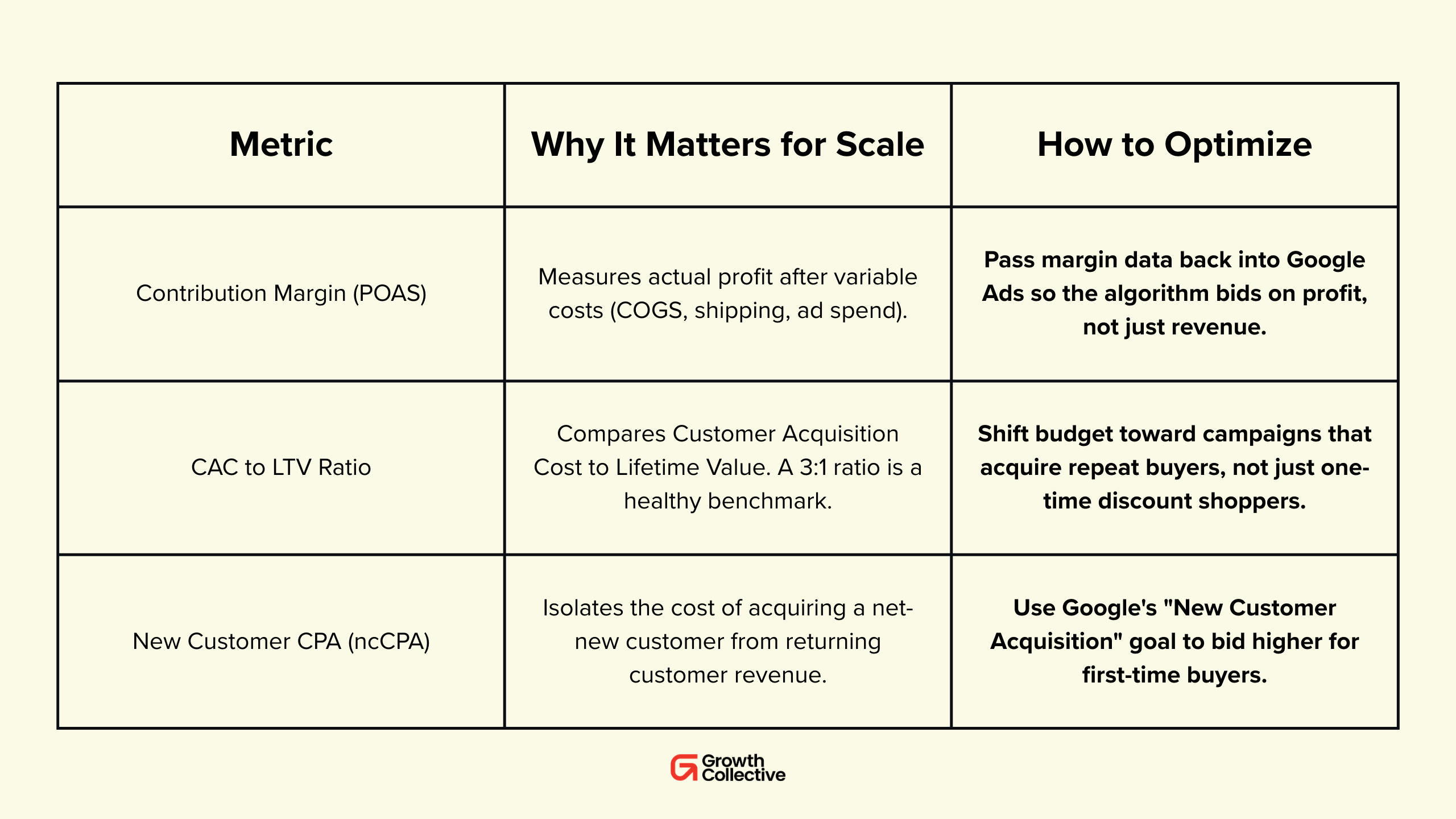
4. Looking Beyond ROAS: The Real Metrics of Profitability
Here is a hard truth: ROAS (Return on Ad Spend) is a platform metric, not a business metric. A 400% ROAS means nothing if your cost of goods sold (COGS) and shipping eat up 80% of your revenue. To build a $10M profit engine, you need to track advanced financial metrics.
The Bottom Line
Scaling from $5M to $10M in e-commerce requires moving from a tactical mindset to a strategic one. By treating Google Ads as a full-funnel ecosystem, leveraging smart automation, deeply integrating your first-party data, and optimizing for true business profit (not just platform ROAS), you can build an independent growth engine that doesn't hold you hostage to the whims of social media algorithms.
Ready to Turn Your Google Ads into a True Profit Engine?
Implementing full-funnel strategies, value-based bidding, and margin-focused tracking is complex, and getting it wrong at this stage of growth can be expensive. If you are a $3M+ e-commerce brand tired of shrinking margins and ready to finally break through the $10M ceiling, let’s look under the hood.
Book a Free Google Ads Profitability Audit. On this one-on-one strategic call, we won't just look at vanity metrics or platform ROAS. We will dive deep into your account architecture, uncover hidden profit leaks, and map out a custom, data-driven blueprint to scale your revenue sustainably.